


When my son started kindergarten, he was electric with excitement. He spotted a friend from daycare the moment he walked in, and the two of them lit each other up like only five-year-olds can. For his mom and me, it was a beautiful moment. We loved the idea of James spending his days learning, exploring, and being curious. It felt like the right beginning.
One of the special things about kindergarten is that it can be a near-perfect environment for learning with curiosity and passion. There are no tests to “teach to,” and there is very little to memorize (though memorizing certain things matters too). In kindergarten, it’s still okay not to know the answer to something. In kindergarten, it’s still okay to ask questions.
Kindergarten teachers are, in my experience, talented and deeply caring educators. They are excellent guides for young minds to pursue their curiosity and wonder. Equally important, in kindergarten there are plenty of other curious kids to bang ideas around with.
One of the last times in our education system when kids are encouraged to learn with eyes wide open and with a beginner’s mind — because, as Sir Ken Robinson warned, “we don’t grow into creativity, we grow out of it; we get educated out of it” — is in kindergarten.
Kids who look at the world with enquiring minds are far more likely to thrive — especially in a world changing as fast as ours — so it matters that we, as parents, help them keep the spirit of kindergarten alive as they grow.
It’s Never Too Late to Begin Again
No matter how old our kids are, we can borrow a page from a great kindergarten teacher and keep encouraging them to ask questions. Even better, we can teach them how to ask beautiful questions.
The next post will dig into how to create a beautiful question. For now, let’s look at why we need to in the first place.
Why Should I Teach My Child to Ask Better Questions?
Asking our children meaningful questions invites them to think deeply about the world around them. A beautiful question from us shows that we think deeply too — and that we find joy and meaning in things, including our kids. A child who learns to ask good questions will enjoy a much freer life, one less burdened by false assumptions. She will think less in terms of “right” and “wrong,” and be more flexible in her thinking. Importantly, she will also learn how to make better decisions.
A child who knows how to ask good questions carries a lighter load through life. She’s less trapped by assumptions, less hemmed in by right-and-wrong thinking, and far more able to shift perspectives. And that flexibility — that willingness to look again — is what leads to wiser decisions.
If a person can’t ask a good question, they will not be able to think very clearly at all. After all, curiosity is the root of all knowledge. Agriculture, books, braided hair, π, and even schools themselves are the result of a person or a group of people asking “Why?” “How?” “When?” “Where?” and “What?”
If you’re a parent of an older child and you’re struggling to get them to do their homework, remember this: there would be no homework to wrestle with if someone hadn’t first asked something like “How do I help a student deepen their learning after school hours?” Questions are, indeed, the root of all knowledge.
Are There Dumb Questions?
Firstly, let’s acknowledge that some questions are rhetorical and aren’t really questions at all. Rhetorical questions are fine, except when they’re intended to shut down rather than open up — to describe rather than to inquire.
“Why do you never do your homework???” — that’s not really a question. It’s an accusation with question marks. It isn’t a dumb question, because it isn’t a question at all. It comes from frustration, not curiosity or any commitment to helping. These “Why’s” are parental cries for help — cries that often land in ways a child can’t quite make sense of.
Since it’s our job to teach our kids good habits, we need to cut out rhetorical and accusatory questions like that. We need to practice asking questions with curiosity instead.
So we discard the rhetorical questions. We decide to actually, genuinely be curious. We try to ask our kids real questions — ones that help them get the help they need, help them help themselves, or simply show that we don’t know and are curious, too.
Where Do We Begin? What Do We Ask?
We start by asking ourselves questions like:
– “What can I do to help my kid get in the habit of doing her homework?”
– “Are there any problems with the material itself — does she need more support?”
– “Is the homework actually valuable for her? Do I need to talk with the school about concerns with the material?”
– “Are there household routines that make it easier or harder to have a good homework schedule?”
– “Should I threaten to light her iPad on fire and jump on it if she doesn’t do her homework tonight?”
– And so on.
Reading the examples above, you can likely see how helpful your curiosity can be. It’s also clear that not all questions are of the same merit. Some are more useful than others. And some questions are thick with negative assumptions and not helpful at all.
It’s clear that once we ask ourselves meaningful questions — and allow ourselves to question our own assumptions — we’ll be in a much better headspace to help our kids excel at school.
And we’re much more likely to get good answers — and good follow-up — from our kids if we ask good, well-timed questions.
Imagine If Your Boss Asked You a Beautiful Question
Why don’t we ask good questions often enough? It’s probably because we’re afraid of looking dumb or like a pain in the butt. Curiosity is pretty heavily disincentivized in many homes, classrooms, and work situations. Curiosity can get you sent to the principal’s office or even fired from a job.
But imagine you made a massive mistake at work. And instead of your boss saying, “Why are you so stupid?” or “Why did you screw that up?” she said, “You blew that one. But was there anything I could have done, as your boss, to set you up to succeed? What if she meant it? What if your boss actually cared enough to hold onto her judgment for a minute and tune in to you? I bet that would feel productive. I bet your loyalty to your boss and your organization would go up a notch or two.
Ditto for your kids. If you demonstrate curiosity and ask good questions, they’ll be far more likely to act well, make good decisions, and question harmful authority with bravery. Why? Because they become part of the process rather than locked out and banging on the door to be let into the magical world of understanding-stuff.
Practice
-
Pause before asking and answering questions. Give space. Is my question a genuine question? Have I given my answer the thinking it merits?
-
Ask no fewer than one genuine “What-If” questions a day. “What if you did your homework on time, young man?” Does not count. “What-if T-Rexes still roamed Earth? How many people would they need for dinner?” (pace Randall Munroe), does.
-
Swap “Why didn’t you…?” for “What would help you…?”
-
Name your own uncertainty. (Big one! If we can say, “I’m not sure, but let me think about it a second,” we have honoured the questioner and now we have a puzzle to solve.)
-
Review one moment each evening where a better question could have helped.
Closing Thoughts
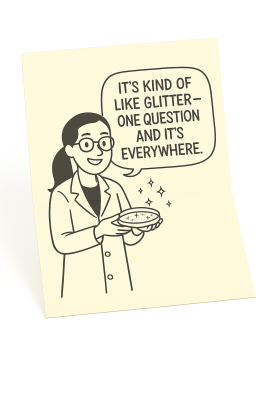
Curiosity is one of many things that grows exponentially the more we use it. It’s like sour dough starter in the fridge. A little bit will get many fed. When we ask our kids better questions, we’re not just helping them think — we’re showing them what thinking feels like. The Kindergarten of Good Questions keeps that early spirit alive in everyday life.
Notes:
*This is an edited and updated version of a very old post called “Teach Your Children Beautiful Questions”.