


Imagine the following scenario: Your neighbour is taking out the garbage. You wave at your neighbour. He doesn’t wave back. Now because you’ve had a hard day, this doesn’t sit right. And in your imagination suddenly he becomes cold, rude, standoffish, or secretly harbouring a grudge about the time your recycling blew onto his lawn.
Or is he?
Let’s slow it down and look at the steps in this should-be-boring moment.
#1: You wave.
He doesn’t wave back.
That’s it. The whole thing. A slice of life so small it barely registers as content.
But we’re human beings and we love a good story so…
#2: The snap judgment.
Immediately your brain leaps to: He’s ignoring me. Not because it’s capital “T” True, but because it’s fast. And fast feels comforting — like grabbing a handrail on a staircase you weren’t expecting.
#3: The meaning you add.
Inside that assumption sits another: People treat me this way. I matter less to him than he matters to me. Now the story is bigger than the moment. You’ve assigned motive, emotion, and biography to a guy holding a compost bin.
(This, we remember, is the exact same guy who came over and watered your plants when you went out of town. Yet, one misunderstanding and all the years of mutual kindness can sometimes be forgotten.)
#4: The instinct you don’t notice.
Deepest inside is the uncomfortable truth: it’s easier to believe someone wronged you on purpose than to consider they simply didn’t see you. Being overlooked stings the ego. Being targeted gives you importance. Our lesser angels prefer meaning over neutrality every single time.
And here’s where things go sideways. Now you’re walking inside, muttering, texting someone about Dave “being weird again,” creating a whole miniature mythology based on a shoulder shrug of a moment. Meanwhile, Dave is chasing a garbage bag, on a call with his vet, or rescuing a raccoon from his porch. He wasn’t ignoring you. He wasn’t doing anything to you. He was just living his unremarkable life parallel to yours.
The Grocery Divider Stick to the Rescue
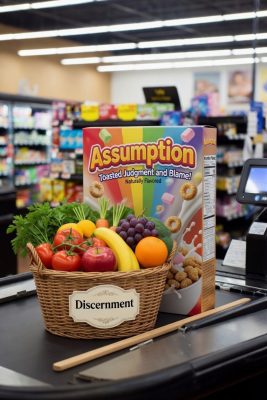
This is where the Grocery Divider Stick cuts through the assumptions. It reminds us to ask the one question that could save you days of emotional gymnastics. It’s the thing that separates your items from other peoples’. On my side of the Divider of Discernment are my beliefs, my assumptions, and my POV. On that side: my neighbours’ beliefs, assumptions, and POV. Sometimes neighbours don’t wave and they generally have good reasons for that. It doesn’t mean there’s a feud on. Sometimes people like pudding cups, too. Or rutabagas. What matters is that before getting offended or grossed out (pudding?!? Rutabagas!?!), we apply a little grace to the situation.
In the case of neighbour Dave’s non-wave, the Grocery Store Divider of Discernment reminds us to ask: “Is there any chance this is simply a mistake or a misunderstanding?”
In the case of pudding cups, well, ok. Maybe they aren’t so bad. And because of the Divider Stick of Discernment there are zero pudding cups in my bag.
The Grocery Divider Stick reminds us to check the size of the story–and emotion–you’re building on top of a moment.
Most of the things that hurt us weren’t aimed at us. They weren’t messages, verdicts, or coded insults. They were just life happening near us — someone tired, distracted, hungry, late, stressed, thinking of something else entirely. If you treat every error as an attack, you end up starring in a drama the other characters don’t even know they’re in.
Or put another way: if you’re going to cast someone in your personal tragedy, at least make sure they showed up to the audition.
The Grocery Divider Stick won’t make you unhurt, but it will keep you honest. It will help you separate their pudding cups, rutabagas, and Jolt Cola from your line of oranges, diet soda, dog food, and baguettes. It will let you taste the discomfort without assigning a villain. And it will save your nervous system from writing forty-chapter feuds based on four seconds of missing information. Moments are tiny. Most moments that don’t go well are mistakes not attacks (even though they may feel awful).
Discerning mistakes from malice helps when there is malice, too. Knowing our neighbour has our back helps us cope with the co-worker who doesn’t! And the Grocery Divider Stick keeps the two from getting confused. Using it is simple, but not always easy.
Here are the steps:
1. Name the moment exactly as it happened.
“I waved. He didn’t.” Nothing added. No embroidery.
2. Ask the Divider Stick question.
“What most probably caused that? If the answer is even a sliver of “probably didn’t see me”, you pause the story-building.
3. Check the boring explanations first.
He didn’t see you.
He was distracted. He was stressed. He was wrestling compost. Boring explanations are almost always truer than cinematic ones.
4. Zoom out to the long-term pattern.
Does this tiny moment match who this person has actually been to you? Or is your nervous system dragging you toward a conclusion they haven’t earned?
5. Scan your own state.
Are you tired? Hungry? Wired? Burnt out? When you’re stretched thin, every miscue feels like a verdict.
The feeling is real; the story attached to it might not be. So mind your side of the conveyer belt!
Assumptions No More!
It’s good to remember that a moment is rarely the whole story. The Divider Stick doesn’t erase the sting—it just keeps you from turning a misunderstanding into a wound. Use it, and the world gets quieter, people get kinder, and the truth gets a fair chance to show itself.