


THE BACK POCKET OF KNOWLEDGE
“We know what we are, but know not what we may be.” — Shakespeare, Hamlet
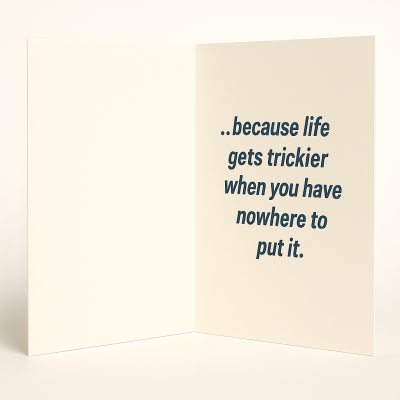
I almost never wear my comfiest pyjamas. Why? Because they don’t have pockets and that complicates things. A pocketless-evening leads to questions such as: “What do I do with my phone while carrying the glass of milk and the cookie to my spot on the couch?”
Sure, I could carry the cookie in my mouth, but, then the milk/cookie ratio will be totally off-set. And one must never mess with the milk/cookie ratio.
So, in a contest between pocket v. no pockets, I will always vote for pockets (except in swim shorts). I’m pro-pocket because they reduce the amount I need to juggle at any given moment, and thus, lessen my mental load.
I like to keep my mental load composed of stuff that is worth its weight.
Knowing where my Kleenex and phone are, while having one hand for my cookie and another for my milk, frees up my brain for more important tasks such as making sense of the Iran-Contra Affair.
HONEY, I KNOW EXACTLY WHERE MY WALLET AND MY KEYS ARE AND I DON’T NEED TO ASK YOU
It’s not easy being married to me for decades. No one ever told my wife that for every year of matrimony, she would be asked more than one billion times to help me find my eyeglasses, keys, wallet, or etc.
“Honey, have you seen my keys?”
“Sweetheart, any idea where my wallet is?”
“Seen my swim goggles?”
“Hey, love of my life, I know you’re running late to the meeting, but can you help me figure out where are the things you bought me to keep the water out of my ears so I stopped needing to ask you to repeat yourself all the time?”
That number of “Honey have you’s” only increased when we became parents.
“Honey, where is the stroller?”
“Darling, seriously, do you remember where I put the stroller? I think the baby is in it.”
(Not a true story. I have lost many things but never my son. That is possibly only because as a baby, I had him strapped to my chest most of the time.)
Anyhow, the simple point is that my wife and I deserved better from me. I needed to figure out how to know where my stuff was (most of the time). This only ended when I decided to keep my wallet, keys and ear buds in the exact same place every time you use them.
Having the knowledge of where your stuff is in your back pocket will spare you hours of looking for things.
BECAUSE THE INTERNET
Apart from the human brain itself, there is nothing more simultaneously useful and harmful than the internet. It can help you learn how to do calculus, but it also helped your grandfather’s neighbour send that racist email. You can make a doctor’s appointment for that scary rash or be convinced that the world is a scary place that is out to get you. (Most of the time, it really isn’t, just don’t read the emails from your grandfather’s neighbour and stay off of X.)
Because the Internet is so Bingeable
The internet enabled smart phone is also the first thing that people from all ages, (exposed) cultures, and demographics are equally addicted to. I don’t know any nine year olds who are raging alcoholics, but, well, Minecraft. And though I have a great deal of respect for the wisdom of my elders, I can’t tell you how many people even older than I am that I have had to plead with to turn off their phones in session. Say what you will about Gen-Z or Millennials being entitled (most of the time, they really aren’t), but the phone fuelled zombie-apocalypse is a crisis that knows no generational boundaries. To paraphrase several sages and Susan Sontag: You can’t scroll and know at the same time.
And then add a car to the internet and the bad just multiplies. Why? Well, lack of preparation, distraction, and high levels of life endangerment generally do not go well together. The internet combined with travelling very fast has lead to all sorts of problems. Unless you just took up bull fighting or street-puddle drinking, it is possible that the most dangerous thing you will do today is use Google Maps on the road. Other people may use, say X, to manipulate the stock market, or to increase global hostilities. None of us is likely to do that today, but we might well do something like drive to an unfamiliar place without checking our route, and end up going the wrong way down a one-way street. (Raise your hand if you’ve ever done something that. I see a lot of hands, including my own.)
Now, I don’t know about you but I remember maps. Real, unfold-them-on-the-kitchen-table-and-plan-out-your-route-in- advance, maps. And because I remember maps, I miss them. I miss living in a world in which people thoughtfully use maps. I think I’ll put more effort into, if not paper maps, at least examining my route on my phone before heading somewhere new.
What happens when you think about where you are going before you get in the car? Well, you probably drive a lot better. You are less likely to make an impulsive lane change because Siri tells you to be in the left lane despite the fact that you’re in the faaaar right one. Knowing where you are going and how you are going to get there means that you can focus on the road a lot better, respond more in the moment to the conditions around you.
Knowing things, having them in your back pocket, means that you don’t need to look them up or scream at Siri when you’ve missed your exit. There’s a reason why your phone will probably call 911 for you if it thinks you’ve been in an accident – the phone might well be the thing causing the accident.
KNOWING THINGS AND SLEEPING AT NIGHT
Are you running brain laps rather than counting sheep? Do you replay the awkward conversations of your day? Even worse, do you replay the same conversation over and over again, getting angrier or sadder, creating more distance than was there in the real conversation? Do you wake up to go to the washroom at two-thirty-five and find yourself worrying about how you will get Susan to ballet and Martha to Girl Scouts and still find time to visit your aunt Virginia in the hospital?
Do you spend hours every night worrying about your boss, friends, or family at the expense of your sanity?
If so, I relate because I would have worried well into the night well into my thirties. And sometimes I still do find myself worrying past my bedtime. To be honest, I’m not sure it’s healthy to never have some times of intense worry. Is it possible that we might even need to care poorly before we can care well. Sounds like a part of being human, to me.
However, too much worry tends to mean that we’ve lost perspective, that our thumb is on the bad side of the scale. Luckily through trial and error, I have become proficient at several strategies for thinking lovely thoughts at night. Admittedly, none of these little brain programs will blow your hair back or fill you with awe. In fact you might just roll your eyes and think, “Duh, Lindsey, that’s so obvious!” But, simple as they are, these little mental programs do work. In fact, that’s why they work, they’re sort of too dumb to fail, while also letting you feel smart.
Below is one of those strategies. Essentially it involves:
1.Deciding to take responsibility for the thoughts in your head
2.Gathering up thoughts you want to have before bedtime
3.Turning to the list in your “back pocket” as an alternative to worrying
It’s kind of like how you might have exercise equipment in your basement for when you feel stressed out, this is putting a simple piece of equipment in your head for when you worry. It’s not easy – nothing worth doing is easy – but it’s simple.
ALL FEELINGS ARE WELCOME
Before we move on, I do want to acknowledge that worry is a vital part of the human emotional landscape. Worry is a part of what makes you human and capable of love. If you didn’t worry, you would be a callous sociopath (or a very nice person who wandered a lot into traffic). Because it is good to worry sometimes, our goal is not to kill our worry. That would be a terrible, dehumanizing goal. Instead, the goal is to learn the difference between two types of worry: 1) the worry that leads to understanding and compassion and/or action and, 2) worry that leads to needless suffering, anger, and alienation. And, when we notice that we are just creating needless suffering for ourselves, practice turning away from pain and towards healthy thoughts.
The goal is to learn the difference between two types of worry: 1) the worry that leads to understanding and compassion and/or action and, 2) worry that leads to needless suffering, anger, and alienation.
I suggest a five minute worrying rule for night. If needed, allow yourself five minutes to worry about your day or to have that imaginary argument with your geography teacher about the B+ that should’ve been a A-. Sometimes give yourself more. Sometimes the dark and quiet are good places to think in. Don’t be afraid to let the good-and-useful worry happen.
Night time can be a good time to gather our thoughts together, to reflect on the day. So, be kind to your night time worry.
Rule # 1: If your worrying is helping, keep worrying. If not, stop. Pull this idea out of your back pocket of knowledge, only when worrying is not getting you anywhere. Use it when you are just digging sadness pits or running brain laps.
The BPK is like a shopping list for worrying less at night. Prepare it and have it within reach for next time you are wandering aimlessly in the aisles of worry. It might not lead to sleep all the time, but at least you’ll be having thoughts you want to have rather than making yourself miserable.
Make a list. Make a list of things you know and care about. It could be of countries or breeds of dog. You could count off one-hundred Pokemon or the ninety-seven Academy Award winners for Best Actress. The content of this little “shopping list” does not matter. The list just has to be numerous enough and fun enough to keep the negative stuff at bay without being so long you find it stressful to remember.
Memorize your list. The whole idea is to have your list ready so you remember the things on it sequentially, rather than ruminating on negative things in circles. But remember, it’s not a test and good enough is always good enough. I frequently forget what the capital of Azerbaijan is. I’ll remember later or I’ll look it up in the morning. What matters is that your list is not too painful to remember when your eyes closed in the dark. If it’s too big of a struggle, you’ll quit and the intrusive thoughts will begin again. I assure you, 1:00 am is no time to worry about what your boss’ tone when she replied, “Fine” to your request for Wednesday morning off to take Bert to the orthodontist.
Pull it out of your “pocket”. When you are ready to stop worrying, remember to remind yourself of your list. Then start thinking about things you like to think about. It might be difficult to avert your mind from your looming Visa balance or Xiao Bao’s rudeness to his piano teacher, but give it a try (a midnight worry-a-thon is not going to clear up your debt or your son’s manners).
I hope this helps you as much as it has helped me and others over the years. Knowledge is power, and knowing that we have things we like to think about and what they are goes a long way to worrying only when it’s useful to worry. Keep your list ready, in your “back pocket”. It’ll save you some woe, could help you sleep better at night, and might even help you like your brain – and its beautiful contents – a little more.